Chinese characters
that finally stay.
Tongda turns the most useful simplified Chinese characters and words into vivid scenes built from people, places, and things you already know.
Get notified as soon as early access opens.
The right characters,
in the right order.
Most apps hand you a textbook table or an exam syllabus. We sort by real-world use, so the characters and words that open up everyday conversation come first, and each one sets up the next.
- Most useful first. Ranked by how often you'll use them.
- Starts where you are. A quick check finds your level.
- Words build on characters. You learn the parts first.
- A solid foundation. 2,000+ characters and 4,000+ words.
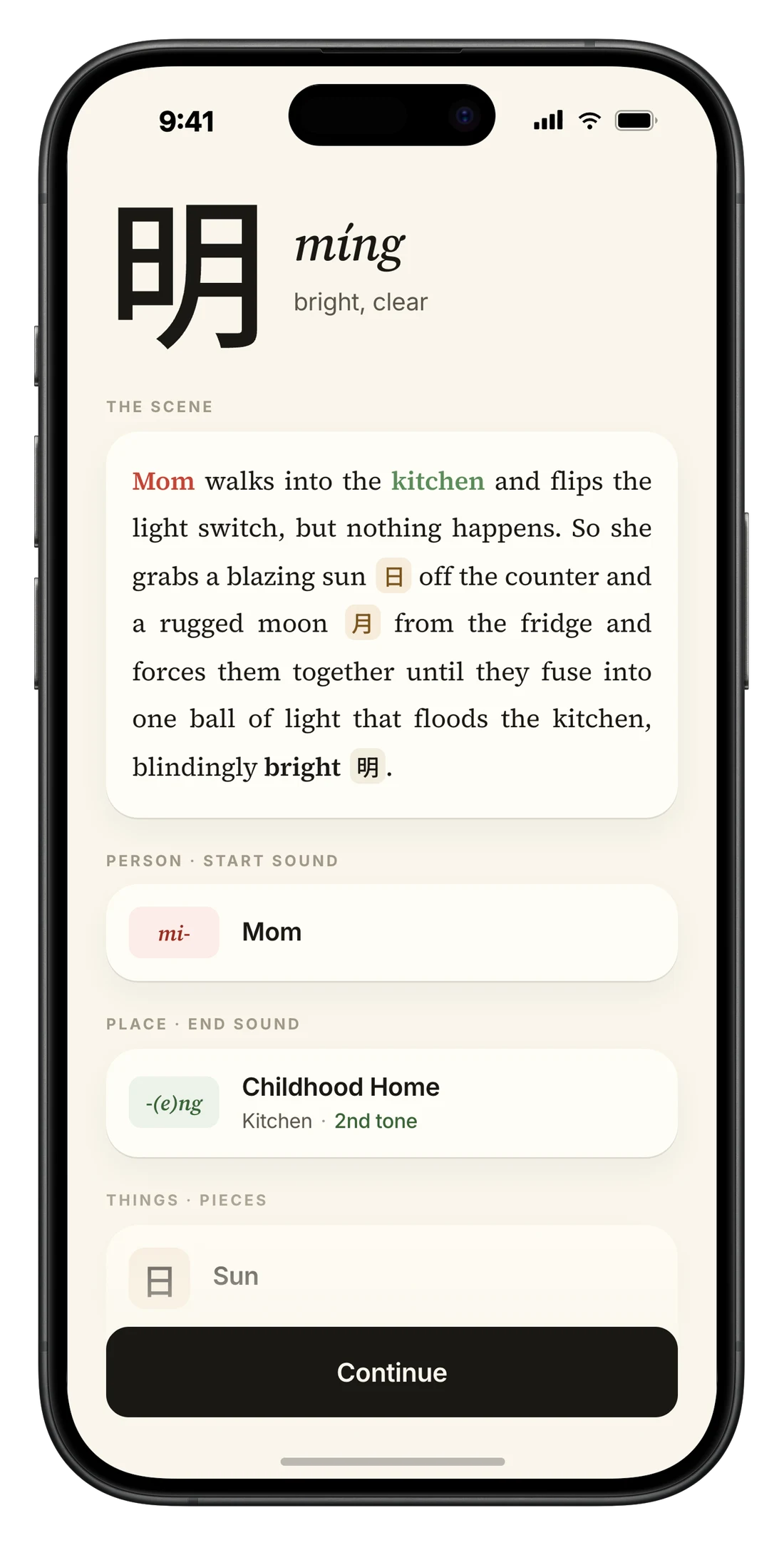
Every character becomes
a scene you can recall.
No more drilling symbols until they blur. Sound, tone, shape, and meaning become one mental image, built on mnemonics and a memory palace, not brute force. And because the same sound always becomes the same person in the same place, every new character reuses anchors you've already built.
A Person
The opening sound calls up someone vivid, from a close friend to a face from film, music, or memory.
A Place
The ending sound sets a familiar place, and the tone puts the scene in a specific room.
A few Things
Each visual component becomes an object you can picture, like a blazing sun, a moon, or a beating heart.
Learn one character.
Quietly lock in three.
Characters are built from each other, so every new one strengthens the pieces inside it. Learn 明 and you've locked 日 and 月 in a little deeper, just by meeting them again.
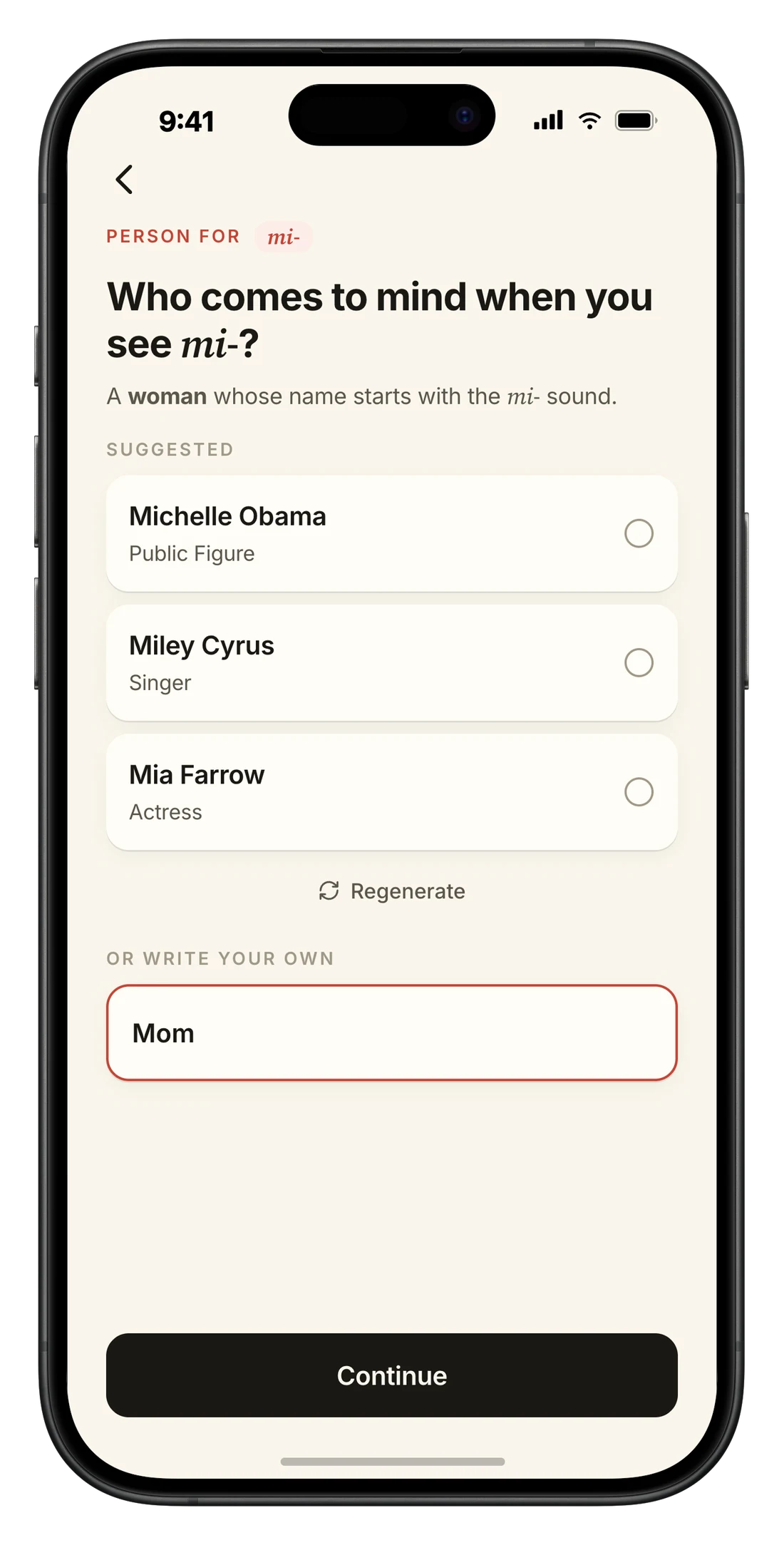
Build the mnemonic once.
The app suggests vivid people and things, then sets them in a place you already know. You can also use your own. Because the scene is made from your world, recall starts with an image instead of a blank flashcard.
- Smart suggestions for every slot. Tap one, or use your own.
- Anchors carry over, returning in every character that shares them.
- One scene captures sound, tone, and meaning all at once.
- Pronunciation built in. Audio for every character and word.
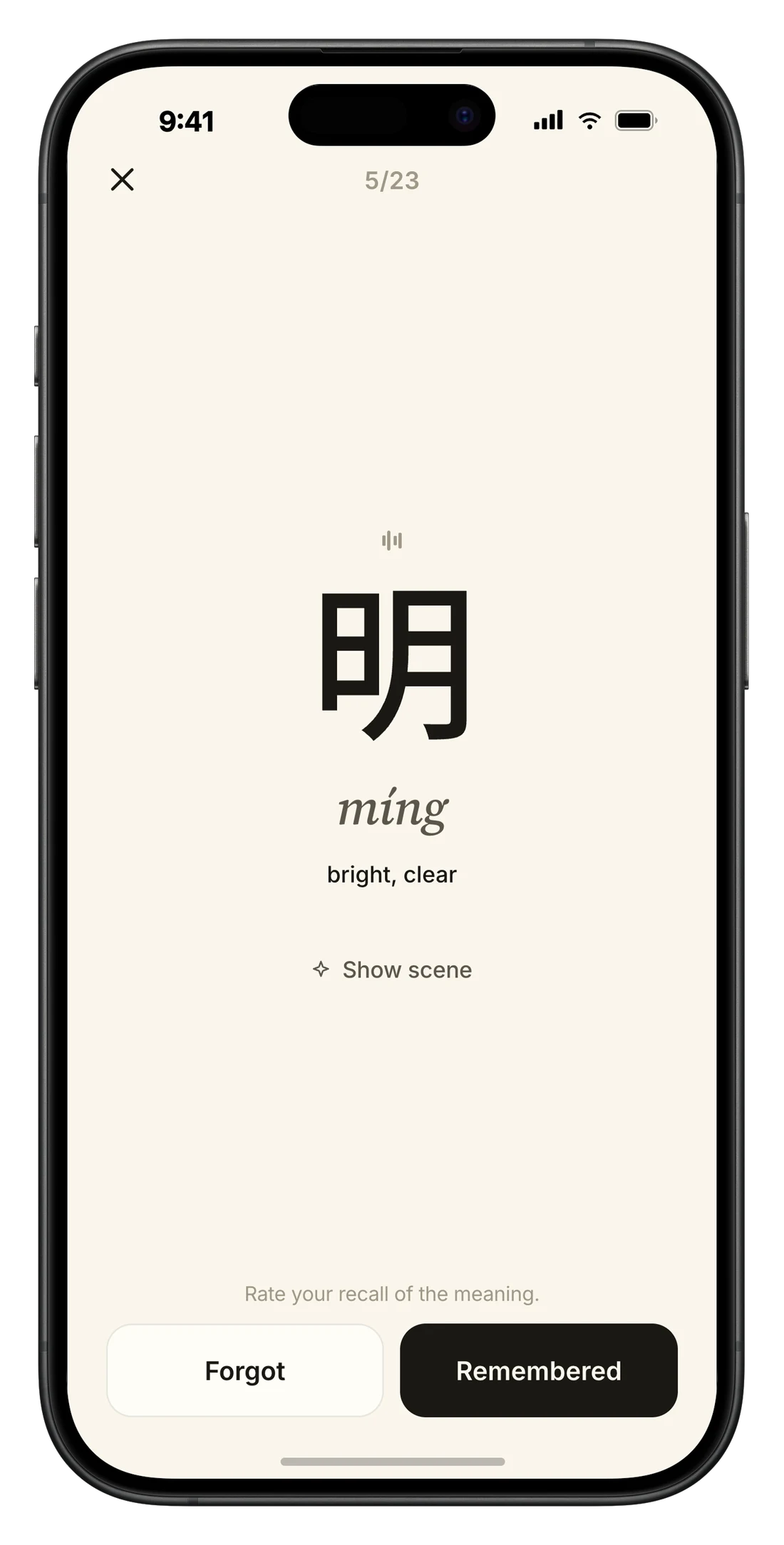
Recall first.
Reveal if you stall.
Reviews ask for meaning and pinyin from memory. Forgot one? The full scene is one tap away, so a stumble becomes a re-anchor instead of a wall.
- Spaced repetition tuned for a light daily load.
- Compound words break into characters you already know.
- Reviews from every angle. Meaning, pronunciation, and listening.
- One tap to grade. Remembered or Forgot, nothing in between.
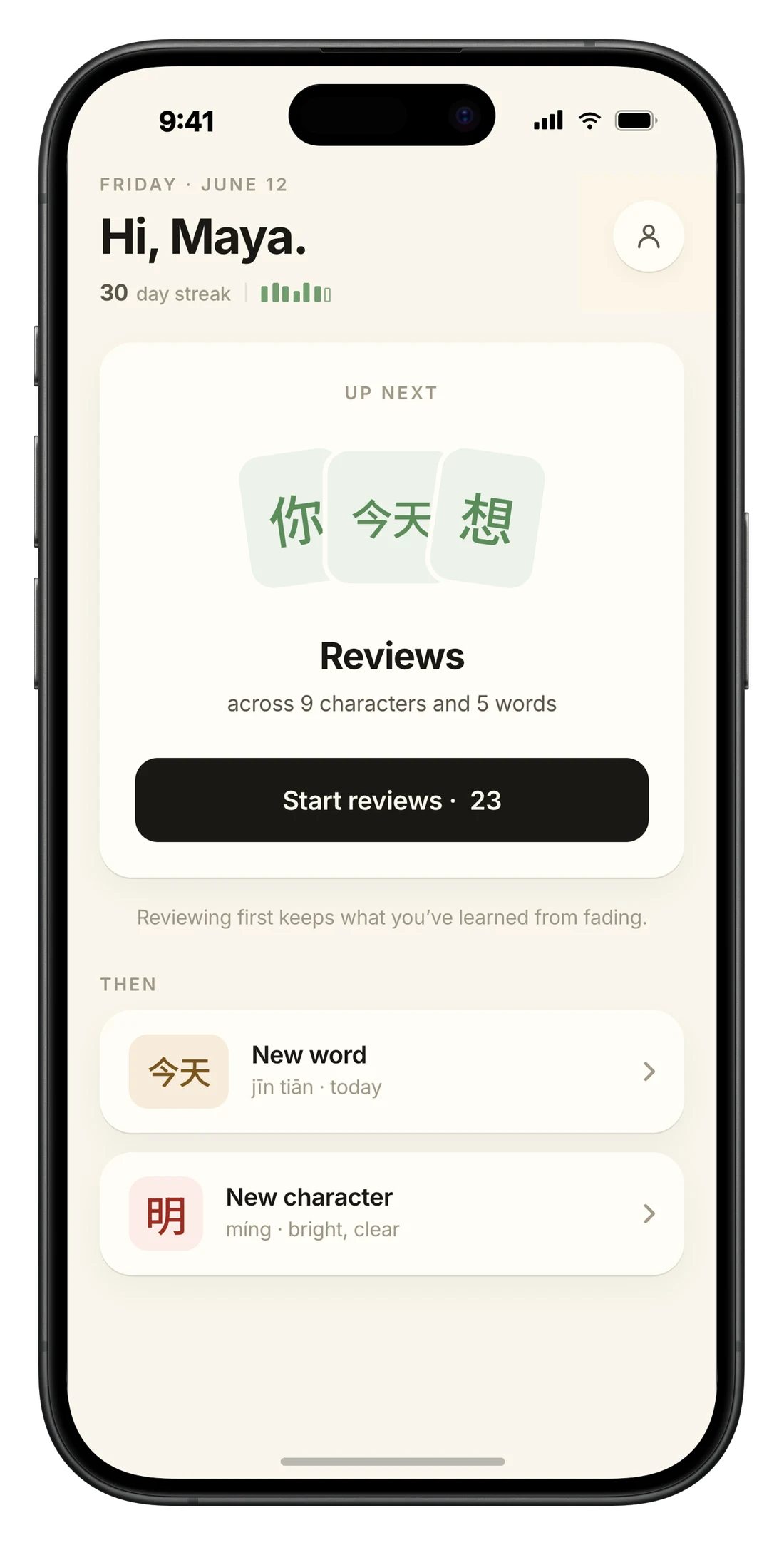
A quiet daily habit.
A streak worth protecting.
Open it and see exactly what's due, what's next, and how far you've come. No noisy gamification, just steady, visible progress in a space that feels good to return to.
- Separate tracks for characters and the words they unlock.
- A map of your recent practice, with your streak front and center.
- Always clear what's next. Open it, see what's due, begin.
- Offline study, coming soon. Review anywhere, no signal needed.
Good things to know
Do I need to know any Chinese already?
Is this based on HSK?
How is this different from flashcard apps?
What's a mnemonic?
Do I have to come up with my own mnemonics?
What's the science behind it?
When does it launch?
Is there an Android version?
Start remembering characters
instead of forgetting them.
Join the waitlist for early access, and we'll email you the moment it opens.
No spam, unsubscribe anytime.